How to Plan Plumbing and Gas Lines for Your Lake Norman Outdoor Kitchen
A homeowner's guide to planning plumbing and gas line installation for Lake Norman outdoor kitchens. Safety, costs, county codes, and shoreline considerations.
Outdoor Kitchens LKN Team
Planning the utility backbone for a custom Lake Norman outdoor kitchen is often the most overlooked phase of the project. Gas, water, and electric run through everything, and getting the routing right determines whether your kitchen functions reliably for decades or becomes a constant maintenance headache.
This guide walks through how plumbing and gas lines should be planned for a typical Lake Norman build, including the county code variations across Iredell, Mecklenburg, Lincoln, and Catawba, and the lakefront-specific considerations like shoreline buffers and rural propane.
The Three Utilities to Plan
Outdoor kitchens involve three primary utility systems:
- Gas for grills, side burners, pizza ovens, fire features, and outdoor heaters.
- Water for sinks, ice makers, beverage centers, and dishwashers.
- Electrical for refrigeration, lighting, fans, and entertainment systems.
Each requires permitted, licensed installation in the lake region. None of them is appropriate for DIY work. This guide focuses on plumbing and gas; electrical considerations are covered separately.
Gas Line Planning
Gas service to a Lake Norman outdoor kitchen comes from one of two sources:
Natural gas is available across most of the developed lake area, including Mooresville, Cornelius, Huntersville, Davidson, and parts of Denver. The home already has natural gas service for the indoor kitchen and HVAC, and we extend the existing line to the outdoor kitchen. Natural gas is preferred when available because it never runs out and costs less per BTU than propane.
Propane is the answer on rural lakefront lots without natural gas service, common in Sherrills Ford, parts of Terrell, and the more rural reaches of Lincoln and Catawba counties. We install propane systems with concealed tank storage built into the kitchen island or hidden in landscaping. Tank sizes typically run 100-500 pounds depending on appliance load.
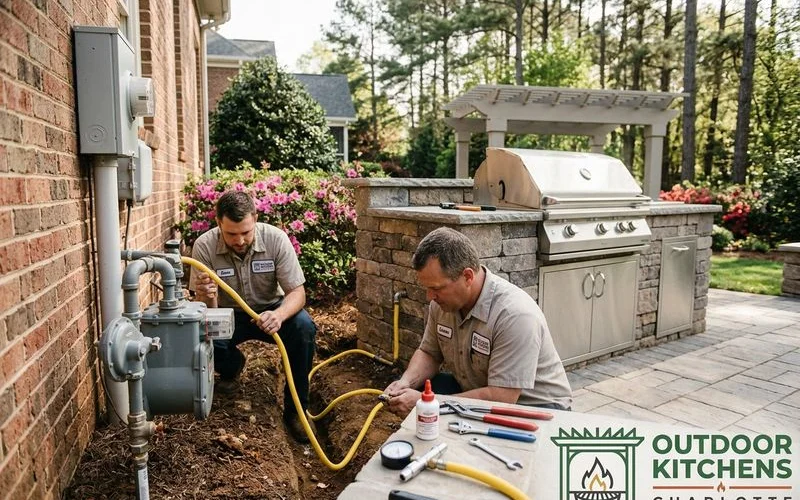
Sizing the Gas Line
Gas line sizing is critical for performance. Undersized lines starve appliances of fuel, causing low flames, slow heat-up, and inconsistent cooking. Oversized lines waste cost. Right-sized lines deliver full pressure to every appliance.
Total appliance demand drives line sizing. Common Lake Norman appliance loads:
- Built-in grill: 60,000-100,000 BTU/hr
- Side burner: 15,000-25,000 BTU/hr
- Pizza oven (gas): 50,000-90,000 BTU/hr
- Fire pit: 60,000-120,000 BTU/hr
- Outdoor heater (infrared): 30,000-50,000 BTU/hr each
- Side power burner: 50,000-90,000 BTU/hr
Total demand for a typical luxury Lake Norman kitchen often exceeds 250,000 BTU/hr. The gas line must be sized to deliver this demand at full pressure even with all appliances running simultaneously.
Most existing home gas service is sized for indoor appliances only. We frequently upgrade the meter and main line as part of an outdoor kitchen project to support the additional load. The local gas utility (Piedmont Natural Gas across most of the region) handles meter upgrades; we coordinate with them as part of our outdoor kitchen installation service.
Gas Line Routing
The routing path from the meter to the kitchen involves several decisions:
- Underground vs aboveground. Underground lines are required across most of the lake region for new installations. Aboveground lines are sometimes acceptable along exterior walls but rarely the best solution.
- Trench depth. Code typically requires 12-18 inches of cover, varying by county. We trench deeper than minimum to allow for landscape work later.
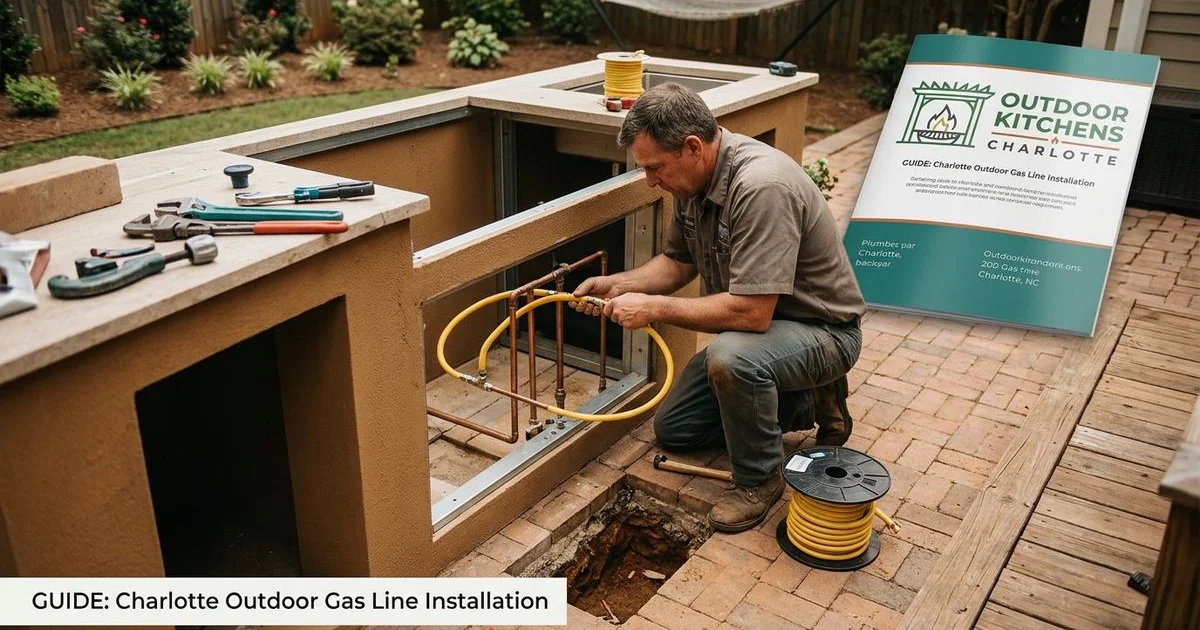
- Material. Yellow polyethylene (PE) gas pipe is the standard for underground runs. Approved transitions to copper or galvanized steel occur near the appliance connections.
- Shutoff valves. Each appliance and the main line at the kitchen need accessible shutoff valves. We label every valve clearly.
- Pressure testing. All gas lines must be pressure-tested and inspected before any appliance is connected. This is a county code requirement and a safety necessity.
Routing should avoid mature tree roots, septic field locations on rural lots, and any future hardscape additions. We map utility runs during the design phase so the kitchen and the gas line plan are coordinated.
Plumbing for Sinks and Ice Makers
Outdoor kitchens with sinks, ice makers, beverage centers, or dishwashers require both water supply and drainage. The lake region’s freeze-thaw cycle adds specific considerations.
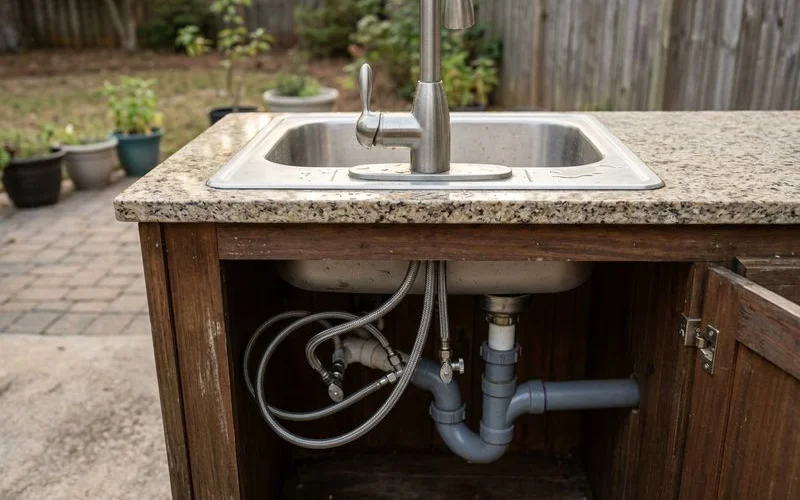
Water Supply Planning
Water supply runs from the home’s main supply line to the outdoor kitchen. Key considerations:
- Cold water only is common. Most Lake Norman outdoor kitchens use cold water only, which simplifies plumbing significantly. Hot water adds cost and complexity for marginal benefit on a typical patio.
- Hot water option. If you want hot water (for cleaning particularly), we run a separate hot line from the home or install a small electric water heater near the kitchen.
- Material. PEX is the standard for outdoor supply lines because it handles the freeze-thaw cycle better than copper.
- Shutoff valves. Accessible shutoff valves at the home and at the kitchen are essential for winterization.
- Backflow prevention. Required by county code on all outdoor water connections.
Drainage Planning
Drainage is more complex than supply because water must flow away from the patio. Options:
- Connection to home sewer. The cleanest option, requiring a drain line from the kitchen to the home’s main drain. Code requires proper venting.
- French drain or dry well. Common for smaller sinks where the water volume is manageable. The drain field must be sized properly for the expected use.
- Connection to septic. On rural lots with septic systems, we coordinate carefully to avoid overloading the existing field.
- Surface drainage. For minimal-use bar sinks, we sometimes use surface grading to direct gray water away from the kitchen and into landscape beds.
The right drainage approach depends on the lot, the soil, and how heavily the sink will be used. We assess every site individually.
Winterization Planning
Lake Norman winters are mild but produce occasional hard freezes. Plumbing systems must accommodate winter shutdown. We design every outdoor kitchen with winterization in mind:
- Shutoff valves accessible from indoors allow water to be cut off without going outside in freezing conditions.
- Drainage back to the home lets us blow out lines with compressed air for full freeze protection.
- Insulated outdoor lines reduce freeze risk for runs that cannot fully drain.
- Heat trace is sometimes installed on critical line sections.
For more on winterization, see our guide on how to winterize your outdoor kitchen on Lake Norman.
County Code Variations
Each county around Lake Norman has slightly different code requirements:
- Mecklenburg County (Cornelius, Huntersville, Davidson) is generally the strictest, with detailed inspection requirements at every stage.
- Iredell County (Mooresville, Statesville) follows similar code but processes permits faster than Mecklenburg.
- Lincoln County (Denver) has standard code requirements with attention to septic field interactions.
- Catawba County (Sherrills Ford) processes permits quickly and follows standard NC code.
In all four counties, gas line work requires a licensed gas technician and pressure testing before final inspection. Plumbing work requires a licensed plumber for any connections to the home’s main system.
Cost Planning
Utility installation costs typically run 8-12 percent of the total Lake Norman project budget:
- Gas line: $1,500-$5,000 depending on length and meter upgrade requirements.
- Water supply: $800-$2,500 for typical sink installation.
- Drainage: $1,000-$4,000 depending on connection type.
- Permits and inspections: $200-$800 across all utilities.
For a typical $75,000 Lake Norman build, expect $7,000-$10,000 in total utility installation cost.
Common Mistakes to Avoid
Across hundreds of projects, these are the most common utility mistakes:
- Undersized gas line that cannot support the full appliance load.
- No shutoff valves where they are accessible during a freeze emergency.
- Drainage routed too close to the home foundation, causing water damage.
- Gas lines routed through future hardscape areas, requiring rework.
- Skipping pressure testing, which fails inspection and delays the project.
- Plumbing run before final island position is confirmed, requiring trench reroute.
A good utility plan accounts for every one of these before construction starts.
Working With Outdoor Kitchens LKN
Our outdoor kitchen installation service includes complete utility planning and installation. Licensed gas technicians, plumbers, and electricians handle every connection, all permits are pulled, and pressure testing and inspections are coordinated end to end. You never deal with multiple separate trades or worry about whether the gas line size is right for your full appliance suite.
Ready to plan the utilities for your Lake Norman outdoor kitchen? Reach out for a free on-site consultation and we will assess your home’s existing service, map the ideal routing, and provide a detailed cost estimate before any work begins.
Outdoor Kitchens LKN Team
Outdoor Living Design Specialist
15+ years designing outdoor kitchens across the Lake Norman region.