Gas vs Charcoal Grill for Your Lake Norman Outdoor Kitchen
Gas or charcoal for your Lake Norman outdoor kitchen? Compare convenience, flavor, cost, and lakefront durability to choose the best built-in grill.
Outdoor Kitchens LKN Team
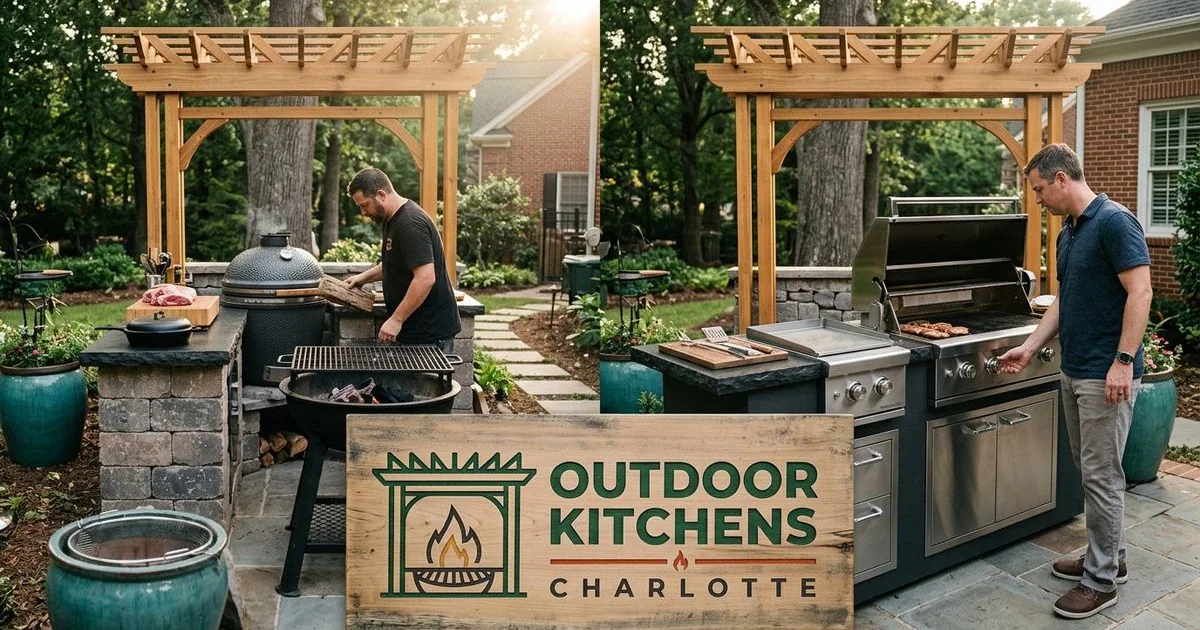
We hear the gas vs charcoal question every single week from clients designing their dream Lake Norman outdoor kitchens. The honest answer: it depends on how you cook, how often you entertain, and what you actually want from the experience. This guide walks through both options with the lake region’s specific conditions in mind.
The Case for Gas
Gas grills win on convenience. Push a button, watch the burners ignite, and you are cooking within minutes. There is no ash to clean up, no charcoal to source, no lighter fluid to manage. For a Tuesday night dinner after a long day at work, gas is hard to beat.
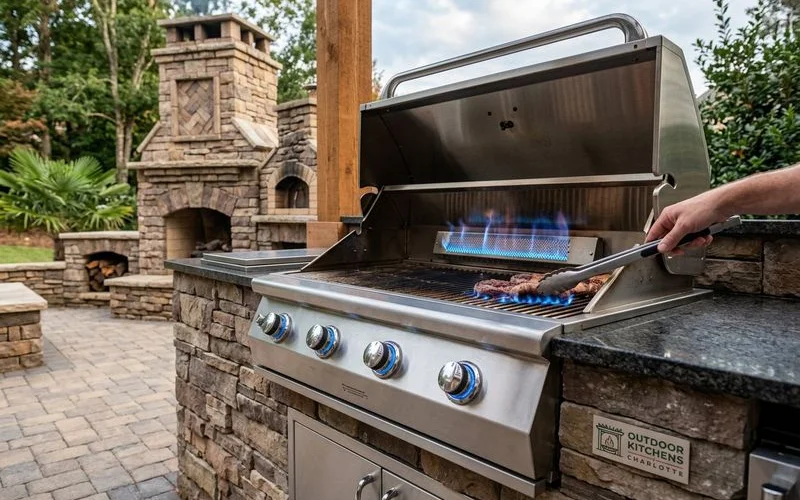
For Lake Norman homes, gas offers several specific advantages:
- Quick startup matters when the family pulls in from the dock and dinner needs to be on the table fast.
- Adjustable temperature zones let you sear on one side and gently cook delicate fish on the other.
- No smoke inside the pavilion, which keeps the seating area pleasant for guests.
- Minimal cleanup because grease drips into a pan rather than coating ash.
- Rotisserie integration is easy with the dedicated infrared back burner found on most premium models.
Premium gas grills from Fire Magic, Blaze, Bull, and Lynx feature commercial-grade construction with marine-grade stainless that handles the lake’s humidity well. Pricing ranges from roughly $1,500 for a quality 32-inch built-in to $6,000+ for top-tier 42-inch units.
The drawback of gas is flavor. Propane and natural gas burn cleanly, which means food cooked over gas tastes like the food itself, not like the cooking method. For some clients, that is exactly what they want. For others, it is missing something.
The Case for Charcoal
Charcoal grills, especially kamado-style ceramic cookers like the Big Green Egg, deliver something gas cannot: deep, authentic smoke flavor. The combination of natural lump charcoal and the right hardwood (oak, hickory, pecan, applewood) infuses meat with flavor that propane simply does not produce.
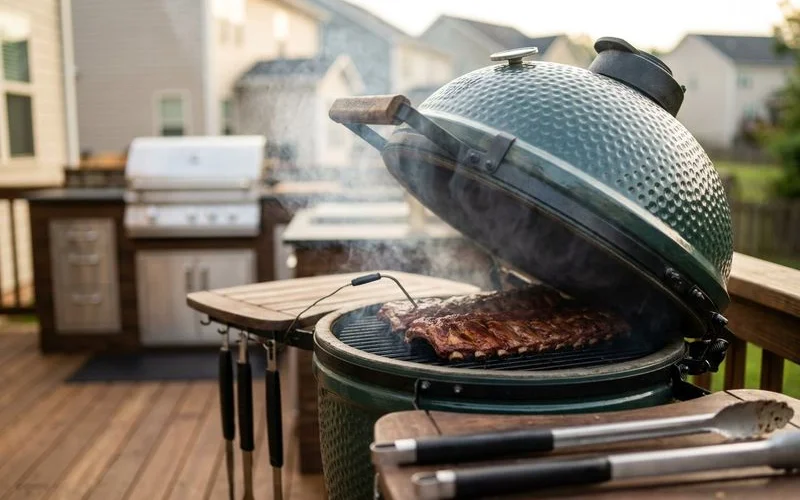
For Lake Norman homeowners who consider grilling a hobby, charcoal opens up a much wider range of cooking techniques:
- Low-and-slow smoking at 225 degrees for brisket, pork shoulder, and ribs.
- High-heat searing at 700+ degrees for steakhouse-quality crust.
- Wood-fired pizza using a baking stone and the convEGGtor heat deflector.
- Whole-bird roasting that uses the kamado’s insulated dome.
- Cold smoking for salmon and bacon at very low temperatures.
The Big Green Egg, Kamado Joe, and Primo are the dominant brands. Pricing for a Large Big Green Egg runs around $1,500 for the cooker alone, with built-in installation and accessories pushing total project cost up considerably.
Charcoal does require more involvement. Lighting takes 15 to 20 minutes with a chimney starter. Ash needs to be cleared every few cooks. Charcoal must be sourced and stored. For the homeowner who enjoys the ritual, this is part of the appeal. For someone who wants dinner ready in 20 minutes flat, it can feel like work.
Side-by-Side Comparison
| Factor | Gas | Charcoal |
|---|---|---|
| Startup time | 2-5 minutes | 15-20 minutes |
| Temperature range | 200-650°F | 200-900°F |
| Flavor | Clean, food-forward | Deep, smoky |
| Cleanup | Minimal | Ash removal needed |
| Cost (cooker only) | $1,500-$6,000+ | $1,200-$3,500 |
| Best for | Weeknight ease | Weekend hobbyist |
| Lakefront durability | Marine-grade options | Ceramics ignore humidity |
| Year-round use | Excellent | Excellent |
Why Many Lake Norman Homes Have Both
Talk to a serious Lake Norman entertainer and they will often tell you the answer is “both.” Premium outdoor kitchens around the lake increasingly include a built-in gas grill alongside a built-in Big Green Egg. The configuration covers every cooking scenario:
- Tuesday night burgers go on the gas grill.
- Sunday brisket goes in the Egg overnight.
- Saturday pizza party uses the Egg with a baking stone.
- Holiday turkey gets the rotisserie treatment on the gas grill.
Building both into a single island requires more space and more budget, but the cooking flexibility is unmatched. Our built-in grill islands service routinely accommodates both within a single design.
Lakefront Durability
Both fuel types perform well in lake-region conditions when you choose the right brands. For gas grills, the key is 304 marine-grade stainless throughout the firebox and burner system. Lower-grade 430 stainless develops rust within a few seasons of lakefront humidity exposure. Brands like Fire Magic, Blaze Professional, Lynx, and Hestan use marine-grade stainless throughout. Mid-range Bull and Summerset units use mostly 304 with some 430 trim, which is acceptable with a fitted cover.
Ceramic charcoal grills like the Big Green Egg are essentially weatherproof. The ceramic shell does not rust, corrode, or degrade under UV exposure. The powder-coated steel bands holding the lid may show minor oxidation over decades, but replacement hardware is inexpensive. For a year-round lakefront cooker, ceramics are hard to beat.
Fuel Sourcing
Natural gas requires a permitted gas line installation, which we handle as part of our outdoor kitchen installation service. Natural gas runs cheaper per BTU than propane and never runs out mid-cook.
Propane is the alternative when natural gas is not available, common on rural lakefront properties in Sherrills Ford and parts of Terrell. Propane tanks need to be refilled or swapped, which is a minor inconvenience but easy to manage with concealed tank storage in the island.
Charcoal is sold at every hardware store and grocery in the Lake Norman area. We recommend natural lump hardwood charcoal over briquettes for serious cooking. A 20-pound bag typically lasts three to five cook sessions.
Cost of Ownership
Beyond the upfront purchase, ongoing costs differ:
- Gas: Natural gas usage runs about $5-15 per month for moderate grilling. Propane costs more per BTU but is comparable.
- Charcoal: A 20-pound bag of quality lump charcoal runs $15-25, lasting 3-5 cooks. Heavy users spend $30-60 per month.
Maintenance for both is minimal. Gas grills benefit from annual burner inspection and grate replacement every 5-10 years. Ceramic charcoal grills are essentially maintenance-free for decades.
Recommendation
For most Lake Norman homeowners, the recommendation depends on cooking style:
- You cook weeknight dinners and weekend cookouts: gas grill is the right choice.
- You consider grilling a passion project: a kamado-style ceramic cooker delivers flavor and flexibility nothing else matches.
- You entertain frequently and have the budget: install both. The flexibility transforms how you use the kitchen.
For a deeper read on specific brands, our guide on the best built-in grills for Lake Norman weather walks through Blaze, Bull, and Big Green Egg in detail.
Getting Started
The right grill is the foundation of your outdoor kitchen, and selecting it should happen early in the design process so the island is built around the specific cookers you choose. Outdoor Kitchens LKN handles every step from selection through installation. Reach out for a free on-site consultation and we will help you figure out which fuel type fits your Lake Norman lifestyle.
Outdoor Kitchens LKN Team
Outdoor Living Design Specialist
15+ years designing outdoor kitchens across the Lake Norman region.